
St. Martin Parole and Probation
Both forms of supervision can place a person in the community under rules and officer contact, but they begin in different ways. A St. Martin Parish court may impose probation after conviction, sometimes with a jail term or credit for time already served. Parole follows imprisonment and a decision or legal release path that permits the person to serve part of the term outside a secure facility. Louisiana good-time release, also called release by diminution of sentence, can also lead to DPS&C community supervision. None of these labels alone states when the person walked out of the parish jail.
The judgment, DPS&C record, and supervising office must agree on identity. A same-name match is weak. Use the full legal name, date of birth, case number, and DPS&C number when those details are lawfully available. Court minutes can show probation, sentencing, revocation, or a later change. The New Iberia Probation and Parole District can then confirm whether its tri-parish office is the correct place for a St. Martin Parish supervision inquiry.
| Point | Probation | Parole or state release supervision |
|---|---|---|
| Starting authority | Court judgment or later court order | State sentence, parole action, or qualifying diminution release |
| Primary record | Criminal case minutes and probation order | DPS&C status, parole record, and supervision assignment |
| Local verifier | Sentencing court and assigned supervision office | DPS&C and the assigned supervision office |
| Proof of jail exit | Separate SMPSO release entry | Separate jail or DPS&C discharge record |
- Probation
- A court-ordered community sentence with stated terms.
- Parole
- Conditional community release after imprisonment and an authorized parole action.
- Diminution
- A reduction in time served through applicable good-time law, subject to eligibility and loss of credit.
- Discharge
- The formal end of a custody or supervision obligation, not just a move between offices.
Note: A supervision assignment can corroborate community status, but it does not supply the exact time SMPSO custody ended.
Verify St. Martin Post-Release Supervision
Begin with the system that imposed or holds the sentence. Parish booking data may establish a jail stay, but it cannot by itself prove probation, parole, or final discharge. The 16th Judicial District Court minutes can identify a probation order or state sentence. DPS&C then becomes the proper channel for a person committed to Louisiana custody. A supervising-office answer can corroborate active supervision, but it is not a certificate of the time SMPSO custody ended.
- Match the person. Confirm the full name, date of birth, court case, and DPS&C number if assigned. Do not rely on a name alone.
- Read the court event. Check the correct district or municipal court for probation, sentencing, revocation, or modification language.
- Check state status. Use the DPS&C inmate-information gateway for a state sentence and preserve its exact status and date labels.
- Call the assigned district. Ask New Iberia P&P whether it is the proper supervising office after giving enough identifiers to avoid a false match.
- Verify the custody exit separately. For a St. Martin jail departure, obtain the Sheriff release or transfer entry. For state discharge, use DPS&C records.
St. Martin Supervision Office Details
DPS&C assigns St. Martin Parish to the New Iberia district with Iberia and St. Mary parishes. Published caseload categories apply to the full district. They are not St. Martin-only counts and should not be used as parish statistics. The office is the most direct contact for a matched supervision inquiry and officer routing. It does not maintain the Sheriff’s parish booking exit time.
New Iberia Probation and Parole District
1221 Adrian Street
New Iberia, LA 70560
Phone: 337-373-0014
Fax: 337-373-0109
Monday through Friday, 8:00 a.m. to 4:30 p.m.
The official New Iberia district page provides the source contact and tri-parish coverage.
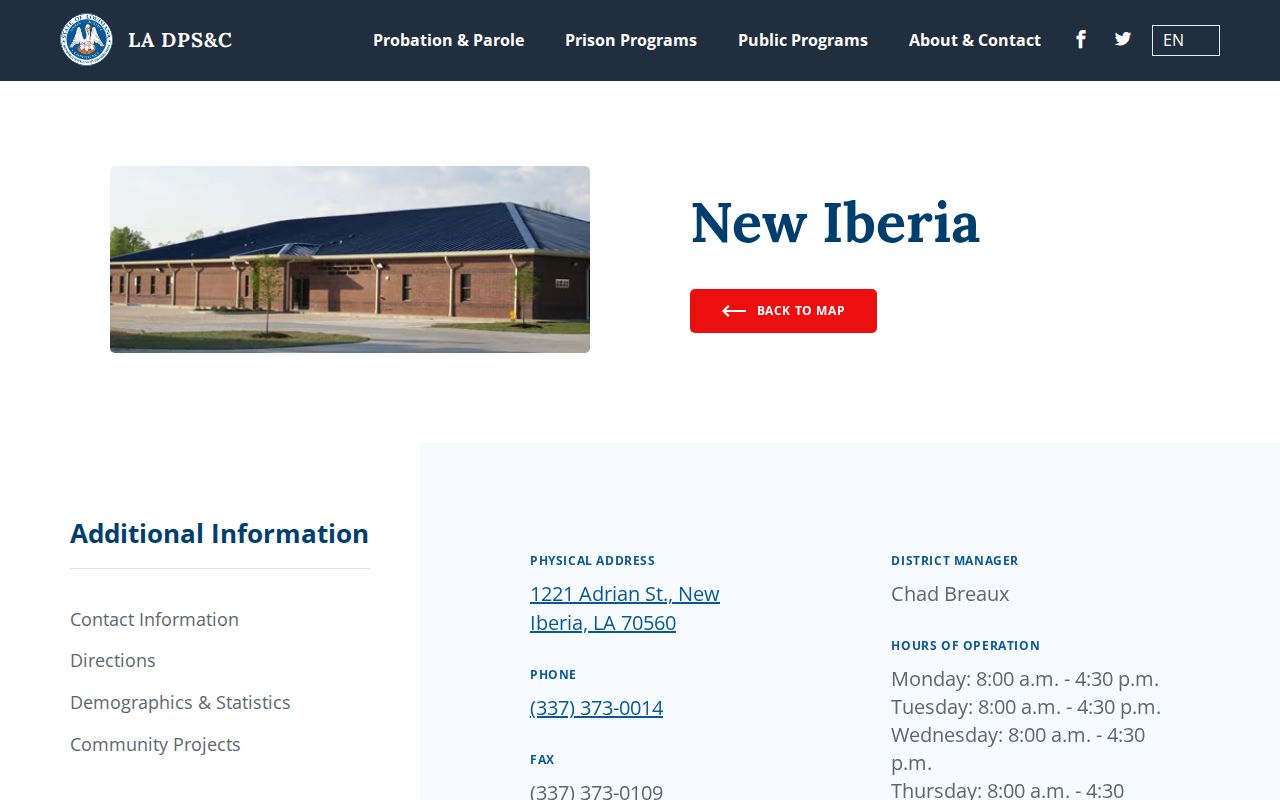
This office view identifies the published DPS&C district contact, which should be matched to the person’s supervision record before relying on it.
Note: New Iberia’s published caseload information covers three parishes and is not a St. Martin-only count.
St. Martin Parole Dockets
The Louisiana pardons and parole hub and its current parole dockets show scheduled hearing-week notices and agendas. A docket entry means a hearing is planned. It is not a release record. Louisiana law calls for an order or denial within 30 days after a formal hearing, but a grant can still be followed by processing, conditions, a detainer, or another custody issue.
Eligibility also depends on offense date and statutory category. R.S. 15:574.22 generally removes parole eligibility for DPS&C-committed people whose covered offenses occurred on or after August 1, 2024, subject to listed exceptions. Earlier and special cohorts may fall under R.S. 15:574.4. Do not turn an eligibility date, docket date, or favorable vote into a projected departure date. Post-Hearing Processing at 225-342-6550 can address outcome routing, while later DPS&C status and the supervision office help confirm what followed.
The linked historical docket system exposes hearing dates and locations across years 2012 through 2026, with search and expand controls. Research did not verify a separate, complete public decisions database with a consistent final-vote field. Search the matched hearing, then seek the later order or case record. An old docket can help identify the correct event, but it cannot show current supervision or whether a later rehearing changed the result.
Note: A parole hearing or grant is an intermediate event; later custody and supervision records establish whether and when release occurred.
St. Martin Supervision Violations
Supervision conditions can include reporting, travel limits, program participation, and compliance with court or DPS&C directions. The exact terms belong to the order and supervision record. A claimed violation may lead to an officer response, warrant, hearing, revocation, or no sustained finding. It should not be described as proved from a rumor or an old custody alert.
No comprehensive official public St. Martin Parish absconder list was verified in the research. An absconder is a person alleged to have stopped reporting or otherwise failed to remain available to supervision. The label does not erase the earlier release, and it does not itself show the current location. Verify a matched case with New Iberia P&P and the court that issued any warrant. The SMPSO Civil Bureau handles criminal warrants, but its website is not a complete public warrant list.
A VINE custody alert should not be stretched into a supervision finding. Louisiana VINE reports participating custody changes, while probation and parole status come from the court, DPS&C, and the assigned district. If an alleged violation results in renewed custody, record which agency now holds the person and whether the event is a warrant arrest, revocation hold, or transfer. Each term describes a different step, and none should be inferred from a roster disappearance.
Revocation also differs from discharge. Revocation can return a person to custody or change the supervision terms after proper process, while discharge ends the supervision obligation. Check the later court or DPS&C action before assigning either label.
St. Martin Reentry Across Parishes
Release destination, home parish, and program site can differ. The Southwest Central Regional Reentry Program serves people returning to St. Martin Parish even though the prerelease curriculum operates through Lafayette Parish facilities. The Acadiana LA-PRI and St. Martin Parish Reentry Network also works regionally through the 16th Judicial District area.
These resources can help a returning person navigate community services. Participation does not prove parole, probation, a release date, or the end of supervision. The court and DPS&C remain the sources for legal status. A program location in Lafayette also does not mean the person’s home parish or sentencing parish changed.
St. Martin Supervision Discharge
Supervision ends through a formal discharge, expiration, court order, or other authorized action. Moving to a new officer, completing a program, or leaving a jail does not by itself close the supervision term. For probation, check the case minutes and discharge order. For parole or diminution supervision, ask DPS&C for the exact status and effective date. If a person was first held at the parish jail, the broader St. Martin Parish released-inmate search path explains how to pair that status with the original release or transfer record.
Keep each system in its lane. SMPSO confirms its custody episode. The court explains its judgment and orders. DPS&C confirms state imprisonment and community supervision. New Iberia P&P can corroborate the local assignment. Match more than a name, preserve the exact wording, and resolve any transfer before concluding that supervision has ended.
When a formal record is needed, ask for the specific order or status rather than a broad personal file. DPS&C states that imprisoned-person records are confidential beyond limited public information, so a full master file may not be available. A narrow request for the maintained discharge date or releasable status is more precise. Court copies and the agency response should be kept with the date they were obtained because later orders can change the legal picture.
Louisiana public-records law broadly covers writings and electronic records used in public business, but specific exceptions still apply. R.S. 44:3 treats initial reports and booking records as public while allowing protected law-enforcement material to be withheld. That does not make every DPS&C supervision note public. Ask the custodian to separate releasable material from exempt content and identify the legal basis for any withholding. The result may confirm a status without exposing the full case-management file.