
St. Martin 72-Hour Release Gap
No distinct official St. Martin Parish 72-hour release feed was found during the July 2026 research sweep. The Sheriff’s jail page links an Online Inmate Search at PublicLogs, but that vendor host did not resolve during testing. The local LAVNS page was available and described incarcerated offenders. Neither channel supplied a verified rolling three-day archive.
A three-day inquiry is still possible. It must be built from agency records rather than a manufactured list. Use exact start and end dates, match each person to one booking, and ask SMPSO whether the jail episode ended by community release or transfer. A roster name may disappear before a written response is ready. Conversely, an update delay may leave stale custody information on a screen.
The official St. Martin Parish jail page identifies the current search routes that begin the custody check.
The screenshot confirms where SMPSO sends current-custody inquiries, while the release history still requires direct booking and records follow-up.
Check St. Martin Three-Day Releases
Write down the three calendar dates first. “The last 72 hours” shifts each hour and can cause confusion when staff search by whole dates. For a weekend, name Friday, Saturday, and Sunday rather than asking for “recent releases.” Use one request per person or clearly identify each person and booking episode.
- Check the Sheriff-linked current search and local LAVNS roster. Save the check time and the exact name used.
- Call booking at 337-394-2566 or the correctional center at 337-394-2500. Ask staff to search the defined calendar range.
- Ask whether SMPSO custody ended, the actual exit date and time, the release or transfer code, and the receiving agency when applicable.
- Submit the Letter of Incarceration request for the same date range. Separately ask for any maintained release or transfer entry.
- Check the correct court minutes for the legal event. Compare the order time with the jail’s physical-processing time.
- Follow any transfer into the receiving system. Do not describe transfer as community release.
The shorter St. Martin Parish 24-Hour Release List process is better when the question concerns an exit reported today. It emphasizes immediate booking confirmation and same-day custody changes.
Note: Use the same exact date span in the phone call, form, and written request so the resulting records can be compared.
St. Martin Release Fields to Request
Because no live three-day release display was verified, its fields cannot be promised. Ask conditionally for the maintained data that answers the question. St. Martin Parish has not published a release-record data dictionary, and public-record exemptions may require redaction. The most useful response joins identity, time, exit type, and destination.
| Requested field | How it helps across three days |
|---|---|
| Full name and identifying details | Separates same-name people and supports a reliable match. |
| Booking number | Ties all dates and events to one parish jail episode. |
| Admission date and time | Shows when the identified custody period began. |
| Actual release date and time | Places the physical exit within or outside the selected three-day span. |
| Release or transfer code | Distinguishes bond, time served, court order, and continued custody elsewhere. |
| Authority and receiving agency | Connects the jail exit to its legal basis and next custodian. |
Do not promise that a Letter of Incarceration will show every field above. The form verifies incarceration for a requested date or date range. If it gives only a period of confinement, the separate release-record request remains necessary for exit category and destination.
The Sheriff’s Letter of Incarceration instructions provide the official date-range route for a past parish jail stay.
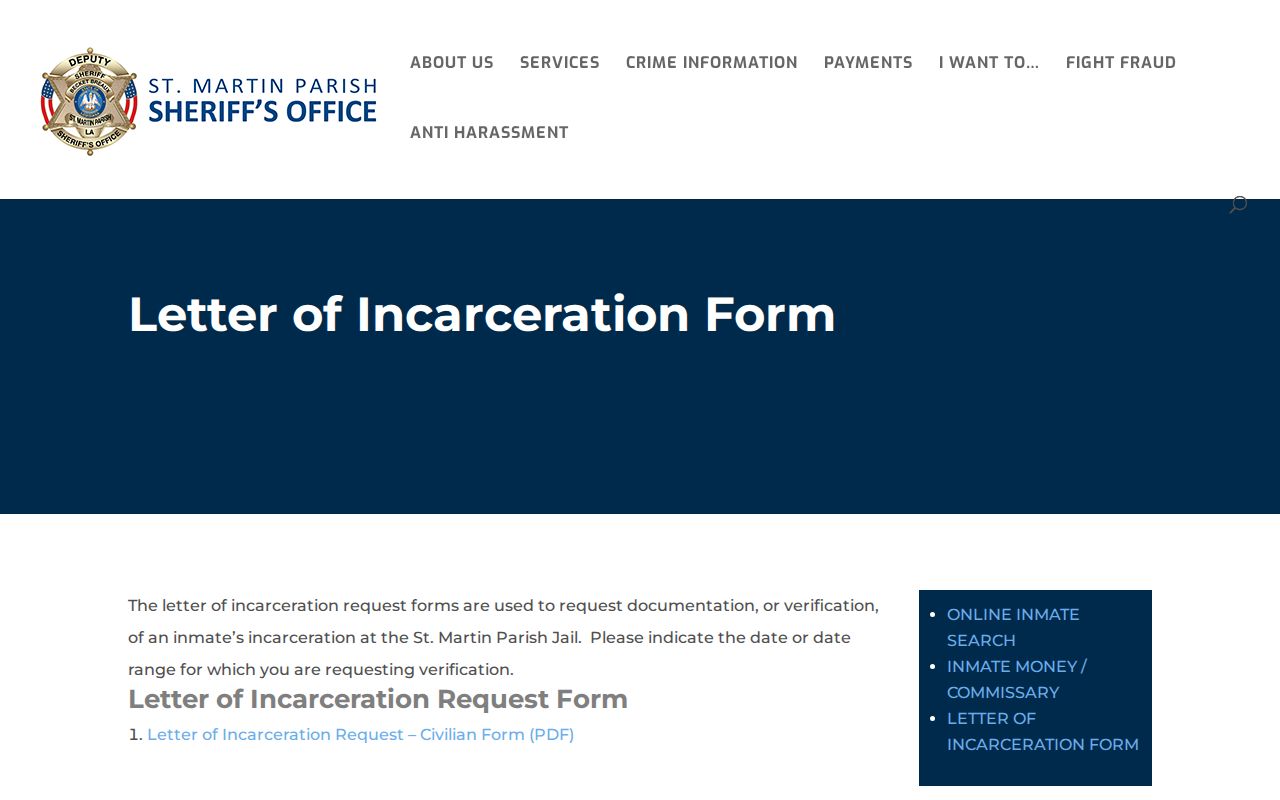
The captured instructions support defining the calendar span, while the added record request seeks release details that the letter may not contain.
Weekend St. Martin Release Timing
A three-day window is most useful when events cross office days. A judge may issue a bond order or sentence on one date, while the correctional center completes identity checks, bond processing, property return, and hold review later. The court timestamp explains authority. The Sheriff’s release time answers when physical custody ended. They need not match.
Holiday periods create the same issue. Use calendar dates rather than business-day language, and ask booking whether a pending order was blocked by another hold. If a transfer occurred after local processing, record both the SMPSO exit and the receiving agency’s entry. One agency’s weekend delay does not set the update schedule for another system.
A bond-out also leaves the criminal case pending. It is not an acquittal or dismissal. A time-served entry means the custodial term was satisfied, but another obligation or hold may remain. Clear labels keep a three-day release review from overstating what the record proves.
St. Martin Release Roster Limits
The local mismatch between sources is a distinctive St. Martin problem. SMPSO’s official website points to PublicLogs, which was unavailable during the research check. The directly branded LAVNS channel was live, but it was limited to currently incarcerated offenders. No official 24-hour or 72-hour release tabs were located. A screen marked “last updated” does not become a historical archive simply because it has a timestamp.
Roster removal can occur before a requester notices it. Data can also lag after a custody change. These opposite effects make a negative result inconclusive. A person may have bonded out, finished time, received a court order, transferred to DPS&C, moved under federal authority, or entered immigration custody. Misspelling, a different identifier, juvenile confidentiality, or expungement can also explain absence.
The St. Martin LAVNS channel shows the local current-custody and notification layer available during the research check.
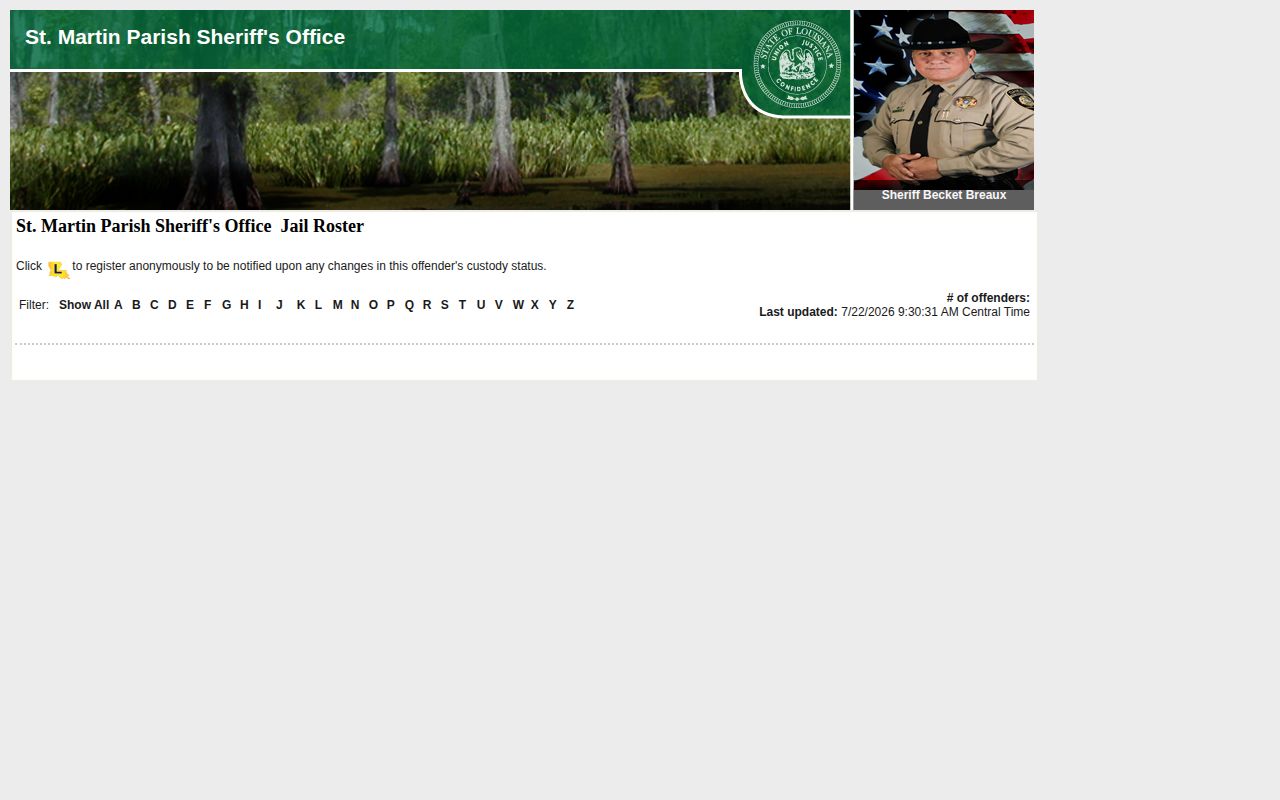
The screenshot reinforces that the live roster reports incarcerated offenders and does not preserve a verified rolling three-day release list.
The durable St. Martin fallback combines the current check, the date-range letter, and a focused release-entry request. LAVNS registration can help prospectively when the person and contributing agency are correctly matched, but an alert is not a certified historical release record.
Note: The July 2026 research sweep found no source establishing photo presence, release fields, cadence, or retention in a St. Martin online feed.
Match St. Martin Court Records
A jail exit record answers when one custodian’s possession ended. Court minutes explain why the legal process changed. In St. Martin Parish, the 16th Judicial District Court record may show bond setting or satisfaction, dismissal, plea, sentence, time-served credit, probation, revocation, or an amended sentence. Compare the closest court event with the Sheriff’s booking and release times.
Jurisdiction matters. The Clerk’s St. Martin 16th JDC product excludes Breaux Bridge City Court, St. Martinville City Court, and Henderson Town Court. A blank district result may mean the case belongs to a municipal court. Federal proceedings follow the federal docket, while juvenile matters are restricted. Start with the charge and filing court rather than assuming every local arrest appears in the district subscription.
The Sheriff’s Civil Bureau is the official local records channel described for criminal records management and reporting requests. Its records and warrants information provides the office route used to locate the proper records custodian.
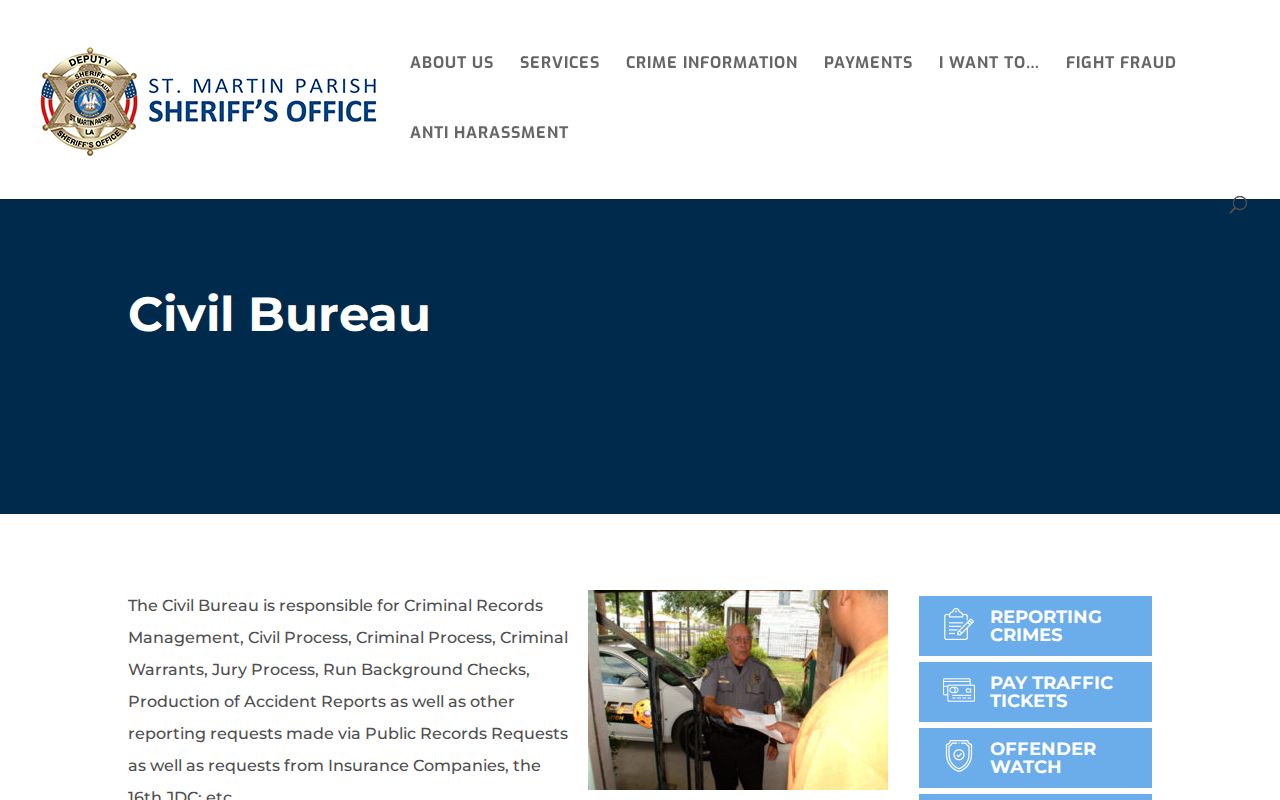
The image supports a written-record path when the online roster does not preserve the three-day history.
St. Martin Release Custody Paths
Each result should end with a custody classification. “Released from St. Martin Parish Correctional Center” is incomplete if another agency assumed custody. The destination field and receiving system determine which statement is accurate.
| Observed outcome | Next confirmation | Safe conclusion |
|---|---|---|
| Community exit after bond or order | SMPSO release entry plus the proper court minute | Parish custody ended; the court case may continue. |
| Transfer to Louisiana DPS&C | Official DPS&C inmate-information gateway | Parish custody ended and state custody continued. |
| Federal transfer | Federal docket and custodian; BOP after commitment | The person left the parish facility but may remain federally held. |
| ICE pickup | SMPSO entry followed by ICE’s locator or contact route | Criminal custody ended locally and immigration custody may continue. |
A current adult roster cannot answer juvenile custody. The St. Martin Sheriff’s Office Juvenile Training Center follows confidential youth processes, so an authorized participant must use the facility or juvenile court. Jail II is historical, non-public-facing property and should not be treated as a second live release feed.
Verify St. Martin Three-Day Releases
Preserve each source in order: the roster check and time, the booking answer, the date-range request, the maintained release or transfer entry, and the relevant court order. Ask the records custodian for inspection or an electronic copy, a cost estimate, and any segregable nonexempt portion if material is withheld. SMPSO does not post a dedicated release-record fee schedule or a promised turnaround, so neither should be assumed.
For a Louisiana state prisoner, use DPS&C only after state commitment or transfer. Its locator is not a history of ordinary parish bond-outs. BOP covers federal custody, not a local jail stay. ICE’s system has its own scope. Matching the last custodian to the correct destination keeps the three-day search accurate.
A phone answer helps with a time-sensitive family or legal inquiry. The written record is stronger for later review because it preserves the agency’s exact code, time, and destination. For one named person whose path extends beyond three days, use the full St. Martin Parish release search. If the record remains unclear, describe only what was confirmed and state which system still needs verification.
Note: A wide date range catches more events, but it never turns a current roster or notification channel into a certified release list.